
A scientific breakthrough on treating Alzheimer’s disease
MindImmune plans to enter the clinic in 2026 to test a new drug candidate to counteract Alzheimer’s disease — before it reaches the brain
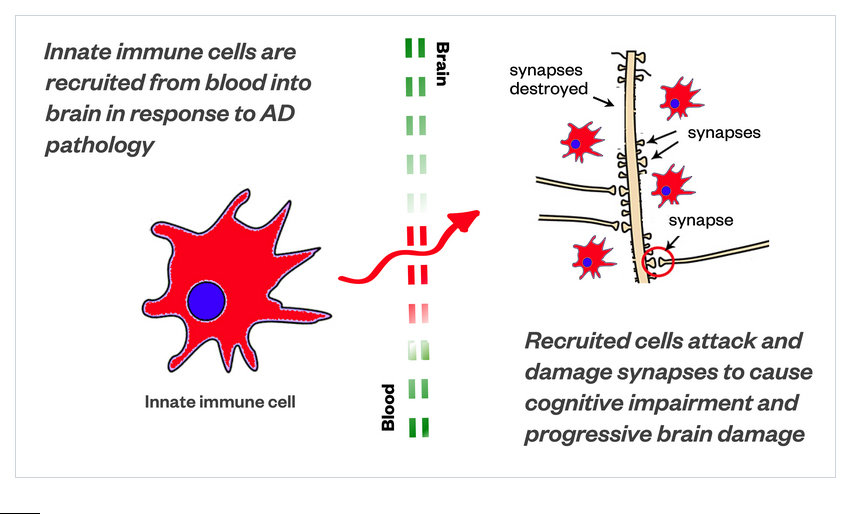
A graphic depiction of how aberrant innate immune cells in the blood pass through the blood brain barrier and disrupt and damage the synaptic process in the brain.
In the meantime, the lack of social services threatens to become a volatile issue in Rhode Island, as numerous shelters are being forced to shut down because of a lack of resources being invested by the state government, according to several community agency leaders.
PROVIDENCE – It seems a bit bizarre be writing about a tremendous research advance in medicine to treat Alzheimer’s disease when the rest of the nation is consumed by a made-for-distraction scientific debate around the alleged risks of pregnant women taking acetaminophen. Really?
But the team of researchers working at MindImmune, a drug development enterprise working out of the University of Rhode Island, recently announced plans to produce a new drug candidate, MITI-101, to seek to counteract Alzheimer’s disease with a treatment that targets immune cells in the blood – and then possibly to repair damaged neurons in the synaptic process. The plan is to bring the drug candidate to the clinic in 2026, culminating a remarkable 30-year scientific research journey.
[Editor’s Note: The cost of treating Alzheimer’s disease, including medical care and unpaid care giving costs for dementia, was estimated to be more than $384 billion in 2025, according to the Alzheimer’s Association. By 2050, the total costs are projected to exceed $1 trillion annually, driven by an increasing number of people living with the disease.]
MindImmune’s amazing journey is one that ConvergenceRI began reporting on in 2016, some 10 years ago. [See links to stories below.] The company is now in the headlines because "US-MindImmune" has just been named as one of the five anchor tenants for the new RI Life Science Hub, announced last week in Providence with much fanfare.
But the research science behind the new drug development for Alzheimer’s disease – and the potential to develop new drugs to treat other chronic autoimmune diseases – heralds a remarkable shift in biology, one that is focused on what is known as the process of immune cell recruitment, immune cells that originate in the blood, not the brain.
As MindImmune founder and CSO Stevin Zorn explained to ConvergenceRI in an in-depth interview on Thursday, Sept. 25, the company plans to enter the clinic in 2026 to test a new drug candidate, MITI-101.
(In a news release, Zorn described MITI-101 as follows: "MITI-101 represents a first-in-class strategy to stop harmful innate immune cells from driving brain inflammation in Alzheimer's and other neurodegenerative diseases. By blocking the infiltration of innate immune cells into the brain, MITI-101 offers a new way to target neuroinflammation — and partnering with Wheeler Bio enables us to advance this groundbreaking science into the clinic with urgency, bringing new hope to patients and families facing these devastating illnesses.")
“We think that Alzheimer’s disease is a chronic inflammatory disease,” Zorn explained. It is one that is associated with the process of immune cell recruitment – “immune cells that originate in the blood, not the brain.”
“This is the peripheral immune system basically attacking the brain,” Zorn continued. “These cells get into the brain, and they cause a synaptic attack. In English, what that means is that they get into the brain, and they cause a cascade of reactions that ultimately damages those nerve endings where they communicate at the synapse. That’s the core feature of Alzheimer’s disease.”
What happens next, Zorn told ConvergenceRI: “Those synapses degenerate. When they degenerate enough, they’re gone, and they can’t be replaced.”
But, Zorn continued, “As they are getting sick, the [neurons] have the capacity to be restored or regenerated. Our data suggests that in the laboratory, after only four days of our antibody treatment, we can actually take a sick neuron and convert it into something that has a more healthy look to it, looking at various synaptic health markers.”
Towards a new biological focus
Here is first part of an in-depth interview with Stevin Zorn, Ph.D. president and CEO of Mind Immune, detailing the plans that the company has to enter the clinic in 2026 with a new drug candidate to treat Alzheimer’s disease.
ConvergenceRI: How are you doing?
ZORN: Doing fine, Richard. I just had some kidney stones removed on Tuesday. I’m recovering. I had my left kidney cleaned out a few months ago. And I had my right kidney cleaned out on Tuesday. It seems like every time I talk to you, one of us is having some kind of surgery.
ConvergenceRI: The good news is that congratulations are in order in becoming one of the five anchor tenants of the RI Life Science Hub.
ZORN: Back when they made the official announcement, we were considering it; we were not part of it. They just recently signed the anchor tenants.
ConvergenceRI: It seems like the culmination of a lot of hard work by your team.
ZORN: We’ve made a lot of progress, Richard. We’re going to be in the clinic next year. We intend to take our lead candidate into the clinic in 2026. That would be the culmination of the work that we’ve done in our 30-year project that came to fruition with MindImmune.
It was Bob’s [Robert B. Nelson, Ph.D., Vice President and Corporate Secretary] idea a long time ago, that these recruited immune cells might have something to do with Alzheimer’s disease.
These kinds of discoveries always rely on building blocks, getting little bits of data over the years, suggesting and suggesting. When we got to MindImmune, we got that very interesting result on immune cell recruitment that I think we talked about previously. But over the last couple of years, we have really shored that up.
And then, once we were convinced that we really see these cells recruiting into the brain, we launched an engineering campaign to find a human antibody therapeutic, which we were enormously successful with.
We came up with hundreds of antibodies and we identified cohorts of those that meet the development criteria.
And so, we have a bundle of riches there. And, we chose a candidate, actually several candidates, and I don’t know if you saw the press release, maybe a week or two ago, it was announced that MindImmune had built a partnership with a company called Wheeler Bio.
ConvergenceRI: I saw that.
ZORN: Wheeler Bio is a CDMO [contract development and manufacturing organization], and they are going to do the cell line manufacturing to actually manufacture our antibody, which we will then use to take into the clinic. So, exciting times.
ConvergenceRI: When you say that you are going to the clinic in 2026, what does that mean?
ZORN: What that means is right now, we are starting to do IND [Investigational New Drug] enabling work, where we have a clinical candidate, and we need to run it through its paces, through toxicology studies, some basic chemical and manufacturing studies, and then file an IND with the regulators, and take it into Phase I trials.
Phase I-A is safety toleration, and single doses in human, healthy volunteers.
And then, Phase I-B is a multi-ascending dose study, where we are giving this, our drug, in a multiple ascending doses, over time, and then assessing that in actual patients. So we will get started with that next year.
ConvergenceRI: Will you be working in a clinic in Rhode Island? Or, will it be in clinics all over the country, or in clinics all over the world?
ZORN: We don’t know where the actual clinics will be. Right now we are discussing this with various CROs [contract research organizations].
And we are getting bids from all of them to figure out: who is going to be the best to work with us? It’s likely going to take 10 or 20 different centers to be able to do these studies. Rhode Island is definitely a candidate for an Alzheimer’s Center, where we would be able to run studies. But it will take more than just one site. Recruiting Alzheimer’s subjects is incredibly difficult.
ConvergenceRI: Will you be collaborating with Dr. Stephen Salloway [Associate Professor of Neurosciences and Psychiatry and Human Behavior at Brown University School of Medicine] and his team at Butler Hospital? Or, is this totally independent of anything that they are doing?
ZORN: Well, they have been working on a different strategy. They have been focusing on the A-beta [amyloid-beta] lowering agents.
We are focusing on immune cell recruitment inhibitors. That’s a different biology. We have not discussed with Steve Salloway whether he would be interested in collaborating with us in our clinical laboratory studies. But, we will be engaging with a variety of clinical KOLs [key opinion leaders] in the next year, as we get closer into the clinic, to work with.
Clearly, Steve is an expert in the field, but an expert in the beta amyloid field.
ConvergenceRI: For me, watching you “give birth” over a period of years, I consider myself fortunate to have followed what you have been doing very carefully. I’ve been waiting to find out: When do you get to the clinic?
ZORN: Right now, we a have vision to the clinic. We have an antibody therapeutic that we have nominated, and it’s called MITI 101, [pronounced my-tee one oh one] and it’s human. Basically, we think it will be safe. And we are going to take it [into the clinic] for safety and toleration studies.
We are designing our clinical studies to try and to get an early read on efficacy in Phase I.
Most Alzheimer’s studies require six-month, or 18-month studies, to see if they work.
There have been some remarkable discoveries in 2025 in the proteomics field, looking at a variety of proteins that change in the cerebral spinal fluid in Alzheimer’s disease, and the reason I said this is amazing is because the whole field has been looking at biomarkers to try and figure out how to diagnose Alzheimer’s, how to track progression of the disease, and in so doing, a number of these biomarkers have come out, and a number of these biomarkers are biomarkers very much related to our mechanism of action.
And so, they go up in the disease, compared to healthy people. They go up with age, they go up with disease severity, and they are very much related to markers that are associated with synaptic damage which we think those cells that are being recruited are doing, and we know how to stop them.
And so, we should be able to use this proteomic approach, brand new, off the presses, to be able to look in Phase I markers at synaptic damage markers, and in Phase I, we should be able to see whether we see indices of reduced immune cell recruitment, that would tell us that we have achieved our proof of mechanism. We would take that as evidence of that.
And, if we can see a reduction with our peripherally administered antibody on these synaptic health markers, we will take that as a proof of principle that, in fact, the mechanism is working, based on these biomarkers that correlate with disease. That ought to be a good enough signal to get us into Phase Two, to do a pivotal study.
ConvergenceRI: You’re about to go into the clinic, but to get from Phase One and Phase Two, what do you see as the gap – or the length of time between those two phases?
ZORN: Phase One can go pretty quickly. Maybe 18 months, two years, something like that. Then, you get into a population of patients, where you really do your definitive studies. You look at cognitive measures, and you do a little bit longer studies.
We would try to make our first Phase II study pivotal. So that we would power that up to try to demonstrate a benefit [in treatment] in the disease, so that we don’t have to waste time or spend a lot of money going all the way through Phase II and Phase III to know that we have a drug.
And, so that’s why we’re trying to come up with some novel paradigms to be able to [achieve] a quick result in Phase I that will tell us and our investors that we have actually achieved our goal.
And then, that preliminary evidence will propel us into Phase II and will demonstrate that definitively.
ConvergenceRI: From my perspective, from the outside looking in, this is very revolutionary. You are changing the way that people are viewing Alzheimer’s disease. Do you see the potential for this approach to be used for other autoimmune diseases?
ZORN: I think that beta amyloid and tau is what everyone talks about when they think about Alzheimer’s disease. Because, over a hundred years ago, Alois Alzheimer discovered you got these particles, sticky brown particles of beta amyloid and these curly tau tangles that became the hallmarks of the disease.
For close to 50 years or so, the industry has been chasing those “biologies” in order to figure out how to arrest the disease. And, that has almost been at the exclusion of everything else – all the other hypotheses that had been proffered over the years, and one of the biggest hypotheses was neuro-inflammation.
So, we knew about neuro-inflammation 20 years ago. But there was so much focus on the beta amyloid hypothesis and then the tau hypothesis that neuro-inflammation didn’t catch on until later.”
Now, it’s really, really clear that neuro-inflammation is at the root of a lot of CNS [central nervous system] diseases, Alzheimer’s being only one of those. There is an immune system in the brain that must play a role. There is also a peripheral system outside of the brain that we think plays a very significant role.
And so that pathology that is happening in the brain is a signal that ultimately, and we don’t know how this works, ultimately causes these cells in the periphery to be attracted, to come into the brain, where they mount the same kind of immune response that they would in a peripheral tissue, like in a chronic inflammatory disease. But like in those peripheral chronic diseases, when the cells recruit into tissues, they mount that response, but then that response becomes maladaptive and takes on a life of its own.
What is supposed to happen is that these cells go in, they mount a response, but they can’t stop whatever is going on. They can’t do that. They’ll sample what is going on, and they will leave the tissue. And then mount a more orchestrated, an adaptive immune response, that’s where you get the big game immune system players that come in and really cause damage.
Some of the data that got us very excited about our hypothesis [was] that we could treat a brain disease by targeting something in the blood. Keeping that cell in the blood so it doesn’t get into the brain is a novel idea.”
ConvergenceRI: We had a headline on a story, and I’m not sure who came up with it, when we talked about “nipping Alzheimer’s in the blood.”
ZORN: “Nipping it in the blood” is still an operational phrase. Yes.
ConvergenceRI: Can I give you credit for the phrase?
ZORN: No, I think you have to give Frank [Frank S. Mennitti, MindImmune’s Chief Science Officer] credit for the phrase.
It’s interesting, because folks like yourself and me understand what “nipping it in the blood” means. You might say: it's quite a catchy description of what Mindimmune is trying to do and that is, to treat a brain disease by targeting something in the blood.
ConvergenceRI: How will this new approach on how to treat autoimmune diseases change treatment options?
ZORN: When you are attacking the immune system like that, B-cells and T-cells, those are the big guns. When you start trying to eliminate those, you are taking a sledgehammer approach to disease. But what we are trying to do is a much more razor-sharp effect.
There are two types of immune cells: the innate cells, which orchestrate the immediate immune response and the adaptive cells. These are the ones, like the B-cells and the T-cells, that basically carry on a longer-term response.
When you get infected with a virus for example or a bacteria, your first line of defense will be these innate cells, which will go and try to clean that up, and if they can’t, then they will sample those, bring them out, to the peripheral immune systems, and then tell the immune system, “We got a problem.” That communication begins to orchestrate an adaptive immune response involving T-cells and then the B-cells will start making antibodies, they will start infiltrating into the tissues. And then, they will remember; the next time that bacteria or virus attacks your system, they will remember, and then they will immediately respond in the future.
The innate cells, the ones that we are talking about, they are the immediate actors. If you can stop a disease at the immediate stage, that whole adaptive system is not part of the disease process later. I think that when you get an aberrant immune response, that can be the cause of the disease; and, if you can find a way to stop that, you can stop disease.
Next week, in PART Two: MindImmune CEO Stevin Zorn talks about the research challenges ahead.


